Every day, your facility generates tonnes of organic waste — food scraps, vegetable trimmings, effluent sludge — that cost you money to haul away and dispose of. R. R. Aqua Products Private Limited engineers a different outcome: we convert that waste stream into biogas you can burn for cooking or power, or into stabilised compost that returns value to soil. We manage design, civil works, mechanical supply, installation, commissioning, and operator training under a single turnkey contract.
Anaerobic Digestion
CSTR Biogas Plants
Continuous Stirred Tank Reactor (CSTR) digesters deliver consistent gas yields for high-solids food waste and organic slurry. Complying with MNRE biogas programme norms.
Why CSTR Technology?
The CSTR configuration maintains the entire reactor volume in a homogeneous, continuously mixed state. This prevents scum formation, short-circuiting, and dead zones that plague simpler pit-digester designs. Feed is introduced daily; digested slurry is withdrawn at the same rate, maintaining a stable Hydraulic Retention Time (HRT).
-
Mesophilic Range: 30 – 38 °C (20-30 days HRT) for optimal stability.
-
Thermophilic Range: 49 – 57 °C (10-15 days HRT) for smaller footprint.
-
Biogas Yield: 90 – 140 m³ per tonne of food waste.
LPG Cost Offset (ROI)
A 5 TPD food waste biogas plant typically displaces around ₹70 lakh/year in LPG or diesel costs. Payback period: 3-6 years.
H2S Removal — Biotrickling Filter (BTF) Technology
Raw biogas contains 500–3,000 ppm hydrogen sulphide (H2S) — which aggressively corrodes engines and boilers. We integrate Biotrickling Filter (BTF) scrubbers using sulphur-oxidising bacteria (*Thiobacillus*) on all projects above 50 m³/day.
- >99% H2S removal efficiency
- Outlet below 50 ppm
- Negligible consumable costs
- Safe for gensets & boilers
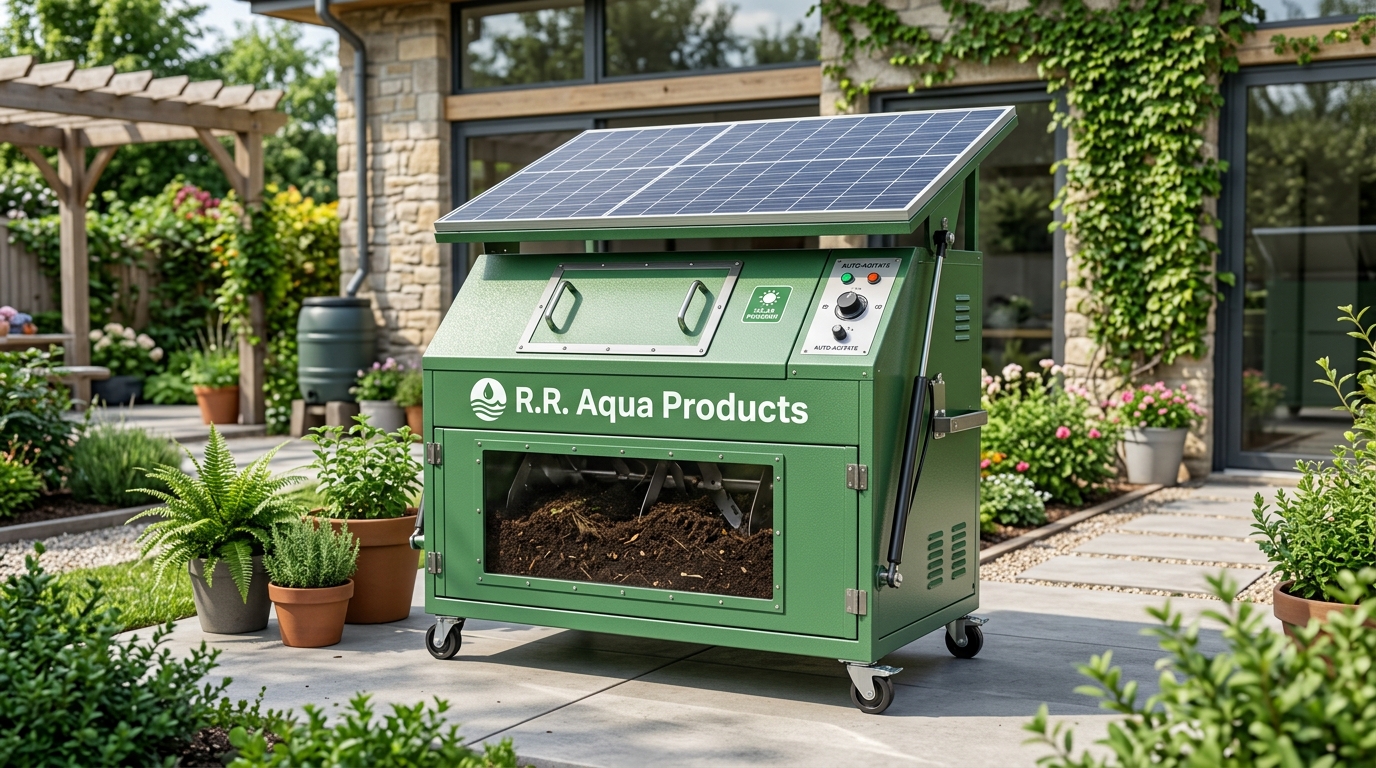
24-Hour Processing
Automatic In-Vessel Composting Machines
Fully enclosed, electromechanical units that complete aerobic decomposition in a single 24-hour cycle — converting raw food waste into dry, stable, pathogen-free compost in one working day.
Available Capacities
| Model | Capacity | Power |
|---|---|---|
| IVCM-50 | 50 kg/day | 1.5 kW |
| IVCM-100 | 100 kg/day | 2.5 kW |
| IVCM-250 | 250 kg/day | 4.0 kW |
| IVCM-500 | 500 kg/day | 6.0 kW |
Ideal for: Hotel kitchens, hospitals, corporate cafeterias, RWAs.
Bulk Organic Waste
Aerated Static Pile (ASP) Composting
For municipal wards, large housing societies, and agricultural processing clusters. ASP is a low-energy, high-throughput method suited to mixed organic streams where capital efficiency is paramount.
Thermal Phase
Maintained at 55–60°C for 15–30 days for hygienic stabilisation and pathogen destruction.
Forced Aeration
Perforated pipe network below the pile with timer-controlled blowers to maintain aerobic conditions.
Humus Formation
4–8 weeks curing phase in windrows for full stabilisation of the organic compost material.
Support & Guidance
Frequently Asked Questions
Food processing waste, hotel kitchen waste, canteen waste, fruit and vegetable market reject, dairy effluent sludge, slaughterhouse waste (with pre-treatment), and organic fraction of municipal solid waste (OFMSW) are all excellent feedstocks for CSTR anaerobic digesters.
A typical 1–10 TPD food waste biogas plant requires 90–150 days from contract signing to first gas production. This includes civil construction, fabrication, microbial inoculation, and the biological start-up ramp.
For a hotel generating 500 kg of kitchen waste per day, the system will produce approximately 50 m³/day of biogas, replacing roughly 21 kg of LPG — typically sufficient for 40–60% of a mid-size commercial kitchen's daily fuel consumption.
In-vessel composting machines are fully enclosed electromechanical units processing food waste in 24 hours — ideal for urban sites. ASP composting is a passive system processing larger volumes over 30–60 days — ideal for municipal or agricultural scale.